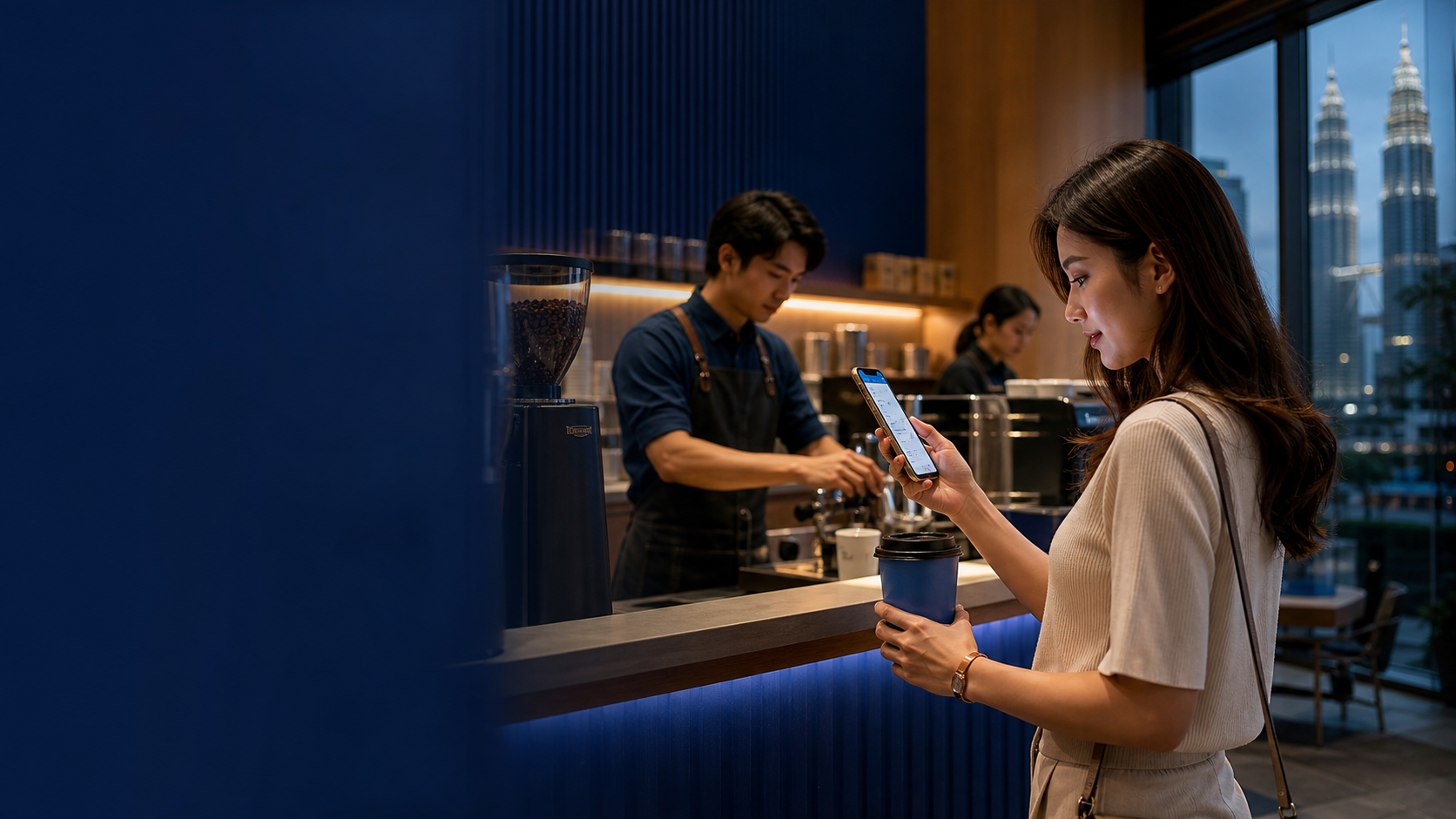
- Customer Data Unification: ZUS Coffee uses a Customer Data Platform (CDP) to merge online and offline customer data, enabling personalised marketing campaigns that drive repeat purchases and app engagement.
- Location Intelligence for Expansion: The brand employs advanced geospatial analytics to select new store locations based on demographic, competitor, and consumer spending data, ensuring each outlet is positioned for maximum footfall.
- Digital-First Brand Positioning: A strong social media presence, controversial marketing tactics, and a student-friendly loyalty app create a powerful, community-driven brand that resonates with young Malaysian consumers.
ZUS Coffee's Data-Driven Customer Engagement Strategy
ZUS Coffee's core marketing engine is its ability to unify and activate customer data through a dedicated Customer Data Platform (CDP), specifically Antsomi CDP 365.
This technology allows ZUS Coffee to move beyond basic email blasts and create a single view of every customer by integrating data from its mobile app, point-of-sale systems, and online ordering channels. The platform's AI-enabled segmentation engine analyses purchase history, frequency, and product preferences to group customers into actionable cohorts. For a business with a rapidly growing customer base, this is a crucial mechanism to avoid message fatigue and ensure marketing spend is directed at the highest-value opportunities.
According to a case study published by the MarTech provider, ZUS Coffee leverages Antsomi CDP 365 to orchestrate personalised omnichannel journeys. A customer who frequently orders a specific iced latte, for instance, can automatically receive a targeted voucher for a new pastry when they are near a store, a tactic known as an Online-to-Offline (O2O) growth loop. This approach directly impacts customer lifetime value by increasing both order frequency and basket size. The system also employs RFM (Recency, Frequency, Monetary) analysis to identify at-risk customers before they churn, triggering win-back campaigns with high-probability offers.
A key constraint of this strategy is data quality. The effectiveness of any CDP is entirely dependent on the completeness and accuracy of the data ingested. For a fast-growing chain, maintaining clean data hygiene across hundreds of thousands of app users requires rigorous governance. The payoff, however, is a marketing system that learns and improves with every transaction, creating a competitive moat that is difficult for less tech-savvy competitors to replicate.
ZUS Coffee's Use of Location Intelligence for Expansion
ZUS Coffee's rapid physical expansion is not based on intuition but on a systematic application of location intelligence software, specifically GapMaps, to de-risk its site selection process.
As the brand scaled from a local player to a regional chain, the cost of a poorly chosen location became existential. To solve this, ZUS Coffee partnered with GapMaps, a cloud-based location intelligence platform. The tool aggregates and visualises critical data layers, including demographic profiles, consumer spending patterns, competitor locations, and traffic flows, on an interactive map. This allows the expansion team to move beyond simple footfall counts and understand the qualitative nature of a location.
Tony Thein, Co-Founder of ZUS Coffee, explained the strategic value in a published case study, stating, "As the coffee market evolves, digital tools like GapMaps keep us agile and proactive. Their accurate insights are crucial for strategic location selection as we scale to even greater heights." The platform enables the team to benchmark potential sites against the performance of existing top-performing outlets, creating a predictive model for success. For example, a site might be evaluated not just on the number of people passing by, but on the concentration of the brand's core 18-30 demographic, their average disposable income, and the absence of a direct competitor within a specific walking radius.
This data-driven approach is particularly critical when entering new markets like Singapore and the Philippines, where local consumer behaviour is unfamiliar. The trade-off is speed versus certainty; a thorough location intelligence analysis can slow down the initial scouting phase but dramatically reduces the long-term risk of an underperforming outlet. For a business operating on affordable price points and thin margins, this precision in capital allocation is a fundamental strategic advantage.
ZUS Coffee's Brand Positioning and Digital Marketing
ZUS Coffee's brand positioning deliberately fuses affordable pricing with a digitally native, culturally relevant identity, making specialty coffee an everyday necessity rather than a luxury for young Malaysians.
The brand's marketing genius lies in its ability to generate organic conversation. Rather than relying solely on polished advertising, ZUS Coffee has masterfully used controversial and meme-driven marketing on platforms like Instagram and TikTok to build a community. This approach, analysed in detail by brand strategy observers, positions the brand as a challenger that understands local youth culture. The visual identity, from cup design to store aesthetics, is engineered to be "Instagrammable," turning every customer into a potential brand ambassador.
This digital-first strategy is tightly integrated with its operational model. The ZUS Coffee app is not just a loyalty tool; it is the central hub for ordering, payment, and engagement. This creates a closed-loop system where marketing messages, offers, and purchase behaviour are continuously tracked and optimised. The brand's focus on students is a deliberate long-term play, aiming to build loyalty with a demographic that will grow in spending power. By offering a student-friendly loyalty programme and maintaining price points significantly below global chains, ZUS Coffee reduces the barrier to entry for premium coffee, effectively expanding the total addressable market.
A potential vulnerability of this positioning is its reliance on a single demographic. As the brand matures, it will need to broaden its appeal without alienating its core base. The challenge is to evolve the brand's voice and product offering to retain customers as they move from university into their professional lives, a transition that requires a more nuanced marketing strategy than pure virality.
ZUS Coffee's Loyalty Program and Customer Retention
The ZUS Coffee loyalty programme, embedded within its mobile app, functions as a gamified data-acquisition engine that directly fuels its personalised marketing and customer retention efforts.
Unlike a simple stamp card, the app-based programme is designed to capture rich first-party data. Every interaction, from ordering a drink to playing an in-app game, feeds into the CDP, enriching the customer profile. This data is then used to power the personalised campaigns described in the customer engagement strategy. The loyalty programme is the front-end mechanism that makes the back-end data unification possible.
The programme's structure is built to encourage habitual behaviour. By rewarding not just purchases but also engagement, ZUS Coffee increases switching costs for the customer. A user who has accumulated points, unlocked a status tier, or customised their favourite order is far less likely to switch to a competitor. This creates a powerful retention loop. The integration of gamification elements, such as challenges and badges, taps into behavioural economics to make the coffee-buying experience more interactive and sticky.
For other businesses, the key takeaway is the symbiotic relationship between the loyalty programme and the data infrastructure. The programme is not just a cost centre for discounts; it is a strategic investment in a proprietary data asset. The limitation is that such a system requires a critical mass of tech-savvy users to be effective. In markets with lower smartphone penetration or digital literacy, the app-first loyalty model would need significant adaptation.
ZUS Coffee's Competitive Landscape and Strategic Challenges
ZUS Coffee operates in a saturated market against global giants and local rivals, and its primary strategic challenge is to sustain its growth trajectory by defending its data-driven moat while navigating rising operational costs.
The Malaysian coffee chain market is intensely competitive, with established international brands like Starbucks and Coffee Bean & Tea Leaf, a wave of new specialty cafes, and value-focused competitors all vying for the same customers. ZUS Coffee's differentiation is its technology stack and brand identity, not just its price point. The integration of Antsomi CDP 365 and GapMaps creates a defensible operational advantage that is invisible to the consumer but impactful on the bottom line.
However, the brand faces significant headwinds. Rising costs of coffee beans, dairy, and rental in prime locations put pressure on its affordable pricing model. Maintaining the quality of the customer experience during hyper-growth is another critical risk; a poorly trained barista or a buggy app update can quickly erode the brand equity built through clever marketing. Furthermore, the data-driven model itself faces the ongoing challenge of privacy regulations and consumer sentiment. As data collection becomes more scrutinised, ZUS Coffee must ensure its personalisation efforts are transparent and provide clear value, or risk a privacy backlash.
The strategic path forward involves deepening its technological integration to drive operational efficiency, potentially using predictive analytics for inventory and workforce management. The brand's success in new markets will be a key test of whether its marketing strategy is a replicable system or a phenomenon specific to its Malaysian roots.