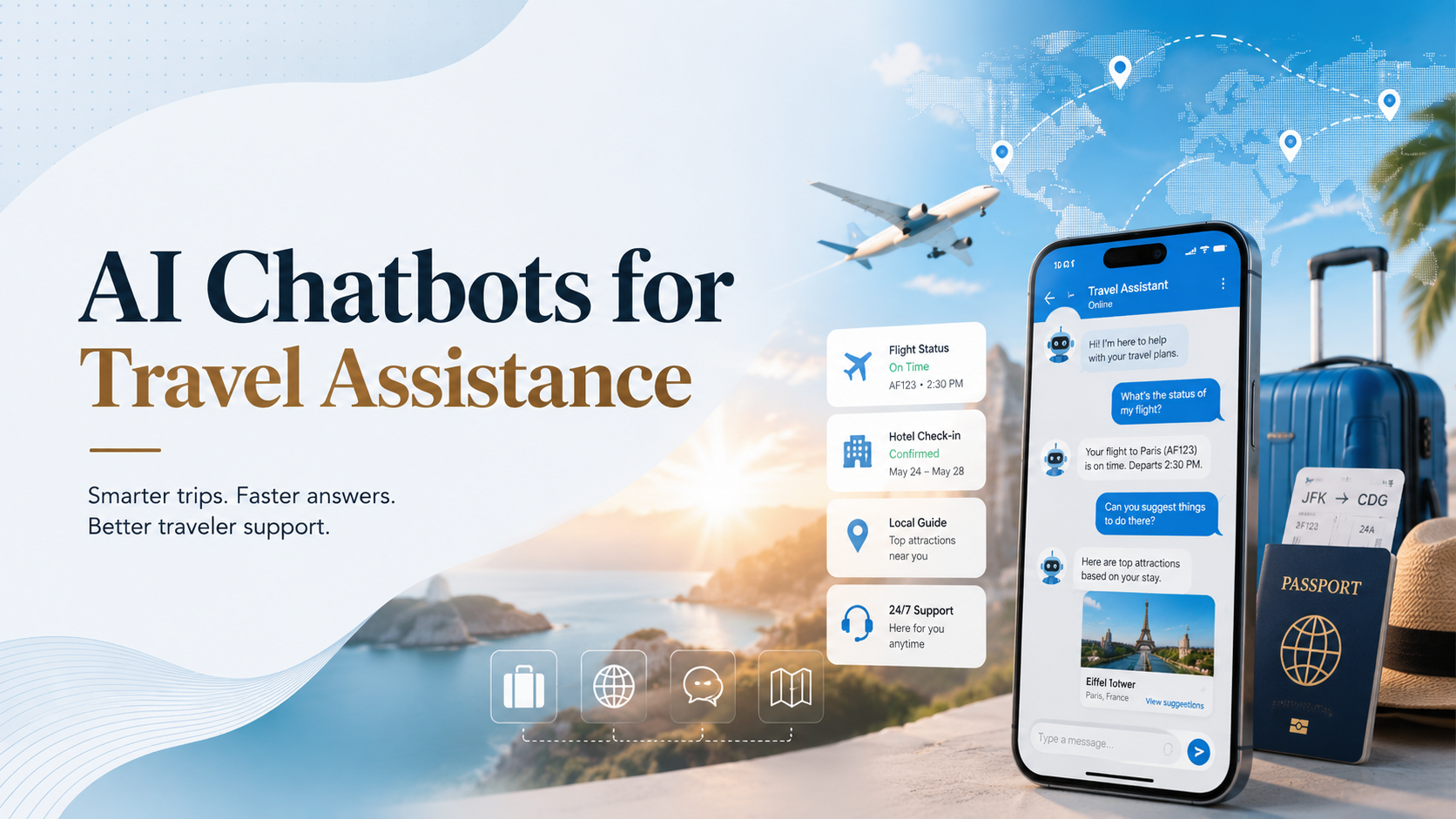
How AI Chatbots for Travel Assistance Work
AI Chatbots for Travel Assistance combine natural language processing with travel data sources to interpret what a traveler asks and return useful answers. When a traveler types a question about flight times or hotel policies, the chatbot matches that request against its knowledge base, which may include the company's own FAQs, live booking system data, or public travel information.
The underlying architecture matters more than the chat interface. A travel chatbot connected to a booking engine can check real-time availability and prices, while a standalone model without integrations can only offer general advice. This distinction explains why some AI Chatbots for Travel Assistance feel remarkably accurate and others produce confident but wrong itineraries.
Most deployments follow a similar pattern:
- Define the highest-volume traveler questions and tasks the bot should own, such as booking changes or baggage rules.
- Connect the chatbot to the systems that hold current data, including the booking platform, CRM, and knowledge base.
- Train the model on approved responses and set clear escalation rules for human agents.
- Launch on the channels travelers already use, such as the website, WhatsApp, or Facebook Messenger.
- Review conversation logs to find repeated failures and update the knowledge base accordingly.
The quality of an AI Chatbots for Travel Assistance deployment depends heavily on that final review step. Travel data changes constantly, and a bot trained once on last season's schedules will quickly drift out of date.
24/7 Real-Time Support Without Expanding Staff
Travel disruptions do not respect business hours. Flights get delayed at midnight, and hotel bookings need changes while the front desk is closed. AI Chatbots for Travel Assistance fill that coverage gap by responding instantly at any hour, which matters for travelers crossing time zones.
The practical value shows up in routine inquiries. Travelers frequently ask about cancellation policies, check-in times, baggage allowances, and local transport options. These questions consume significant agent time during the day and go entirely unanswered at night. A chatbot that resolves even half of those queries frees human agents to handle complex cases that genuinely need judgment.
Real-time support also means the chatbot must access current information. A bot that answers from a static document cannot tell a traveler that their gate changed ten minutes ago. Effective systems pull live data from the booking engine or airline feed so the answers reflect the present situation rather than a stored snapshot.
Automating Booking and Reservation Workflows
Booking automation is where AI Chatbots for Travel Assistance move from answering questions to completing transactions. A well-integrated chatbot can search available flights, present options, and initiate a reservation without a human agent in the loop.
The integration depth determines what the bot can actually do. A chatbot linked to an airline's booking API can check seat availability and prices in real time. One connected only to a website's content cannot complete a booking; it can only redirect the traveler to the manual booking form.
Common booking tasks that travel chatbots handle include:
- Flight searches with date and route filtering
- Hotel room availability checks
- Reservation modifications and cancellations
- Seat selection and add-on purchases
- Payment status inquiries
The edge case that separates good from poor booking automation is the multi-city itinerary. A traveler planning a route through three cities with different airlines and hotel stays generates far more variables than a simple round trip. Chatbots that handle single bookings smoothly often struggle when the request involves multiple segments, different vendors, or complex fare rules.
Personalized Trip Planning and Itinerary Generation
Personalization in AI Chatbots for Travel Assistance means the bot tailors recommendations to the traveler's stated preferences rather than returning generic lists. A traveler who mentions traveling with young children should receive different suggestions than a solo backpacker, even when both ask about the same destination.
Modern travel chatbots build these recommendations by combining the traveler's inputs with structured data about destinations, attractions, and accommodations. Some platforms, such as Mindtrip, organize recommendations into shareable trip plans that include flights, hotels, restaurants, and experiences in one place.
The limitation appears when the chatbot generates an itinerary without verifying that the components actually work together. A bot might recommend a morning museum visit and an afternoon tour that are both excellent individually but geographically impossible to combine. Travelers should treat AI-generated itineraries as a starting draft and verify logistics before booking.
Personalization also extends to remembering context within a conversation. A traveler who mentions a dietary restriction early in the chat should receive restaurant suggestions that respect that constraint later. This conversational memory separates a genuinely helpful assistant from a search engine with a chat interface.
Instant Multilingual Answers for Global Travelers
Travel is inherently international, and AI Chatbots for Travel Assistance handle multiple languages more consistently than human teams of limited size. A single chatbot deployment can answer in English, Mandarin, Japanese, and Malay simultaneously, which matters for agencies serving diverse visitor populations.
The multilingual capability works because the language model translates the traveler's question into an internal representation, retrieves the answer, and responds in the traveler's language. This approach avoids the need to maintain separate knowledge bases for each language.
The trade-off appears in cultural nuance and local terminology. A chatbot may translate words correctly while missing the context that matters locally. For example, a traveler asking about "transport" in Kuala Lumpur needs different guidance than one asking in Tokyo, even though the word translates cleanly. The best deployments pair multilingual models with location-specific knowledge so the answers reflect local realities.
Reducing Operational Costs Through Deflection
The cost argument for AI Chatbots for Travel Assistance rests on deflection: each inquiry the bot resolves without a human agent saves the labor cost of that interaction. High-volume, low-complexity questions deliver the clearest savings because they consume agent time without requiring specialized skills.
The economics shift when inquiries become complex. A traveler disputing a charge or navigating a visa refusal needs human judgment, empathy, and the authority to make exceptions. Pushing those cases through a chatbot frustrates the traveler and often ends in escalation anyway, creating a worse experience at no cost saving.
Operational cost reduction also comes from consistency. Human agents vary in accuracy and speed, while a well-configured chatbot delivers the same answer every time. This consistency reduces the cost of correcting errors and the reputational damage from wrong information.
The realistic financial picture includes the cost of building and maintaining the chatbot. Integration work, ongoing knowledge updates, and monitoring all require investment. Organizations should compare that total cost against the labor savings from deflection, not assume the chatbot is free once deployed.
Choosing the Right
Selecting among AI Chatbots for Travel Assistance requires matching the tool's capabilities to the specific gaps in the travel operation. The table below compares the platforms most frequently cited in travel chatbot evaluations.
| Platform | Primary Strengths | Pricing Model | Best Fit |
|---|
| Zendesk | Customer service integration, agent handoff | Tiered subscription | Companies already using Zendesk for support |
| Botsonic | No-code setup, website deployment | Tiered subscription | Small teams needing quick launch |
| Yellow.ai | Multilingual support, omnichannel reach | Tiered subscription | Enterprises serving multiple markets |
| Flow XO | Workflow automation, channel connections | Tiered subscription | Teams wanting simple automation |
| Verloop.io | Conversational AI for support volume | Tiered subscription | High-volume support operations |
| Freshchat | Live chat plus bot capabilities | Tiered subscription | Companies using Freshworks suite |
| Engati | Bot building with multi-channel options | Tiered subscription | Budget-conscious deployments |
The evaluation should start with the integration question. A chatbot that cannot connect to the existing booking system or CRM will require manual workarounds that erode its value. Confirm which APIs the platform supports and whether the travel company's technology stack appears on that list.
Channel coverage matters equally. Travelers initiate conversations from websites, messaging apps, and social platforms. A chatbot that only works on the company website misses the travelers who prefer WhatsApp or Facebook Messenger, which are dominant channels in many Asian markets.
The decision-fit note in the table reflects a broader principle: the best chatbot is the one that fits the existing operation, not the one with the longest feature list. A travel agency with five staff members needs a different solution than an international airline handling millions of passengers.
Implementation Best Practices for Travel Chatbots
Successful deployment of AI Chatbots for Travel Assistance follows a pattern that prioritizes scope control and continuous improvement. Organizations that try to automate every traveler interaction at once typically end up with a bot that handles none of them well.
Start with a narrow, high-value use case. A hotel chain might begin with booking modifications and check-in questions before expanding to restaurant recommendations and local activity bookings. This focused approach allows the team to perfect the workflows that matter most before broadening the bot's responsibilities.
Human escalation must be designed into the system from the start. Clear rules for when the chatbot transfers to a human agent prevent the frustrating loops that occur when a bot cannot resolve an issue but also will not hand off. The escalation path should be visible to the traveler, who should never feel trapped in an automated conversation.
Monitoring and updating the knowledge base is an ongoing responsibility, not a launch-day task. Travel policies, schedules, and offerings change continuously. Teams should review conversation logs regularly to identify incorrect answers, outdated information, and new question patterns that the bot cannot handle.
The final consideration is transparency about the bot's limits. Travelers should know when they are speaking with an AI and should have a clear path to human assistance. This honesty builds trust and reduces the frustration that comes from discovering the limitation mid-conversation.