What AI Chatbots for Mental Health Crisis Support Can and Cannot Do
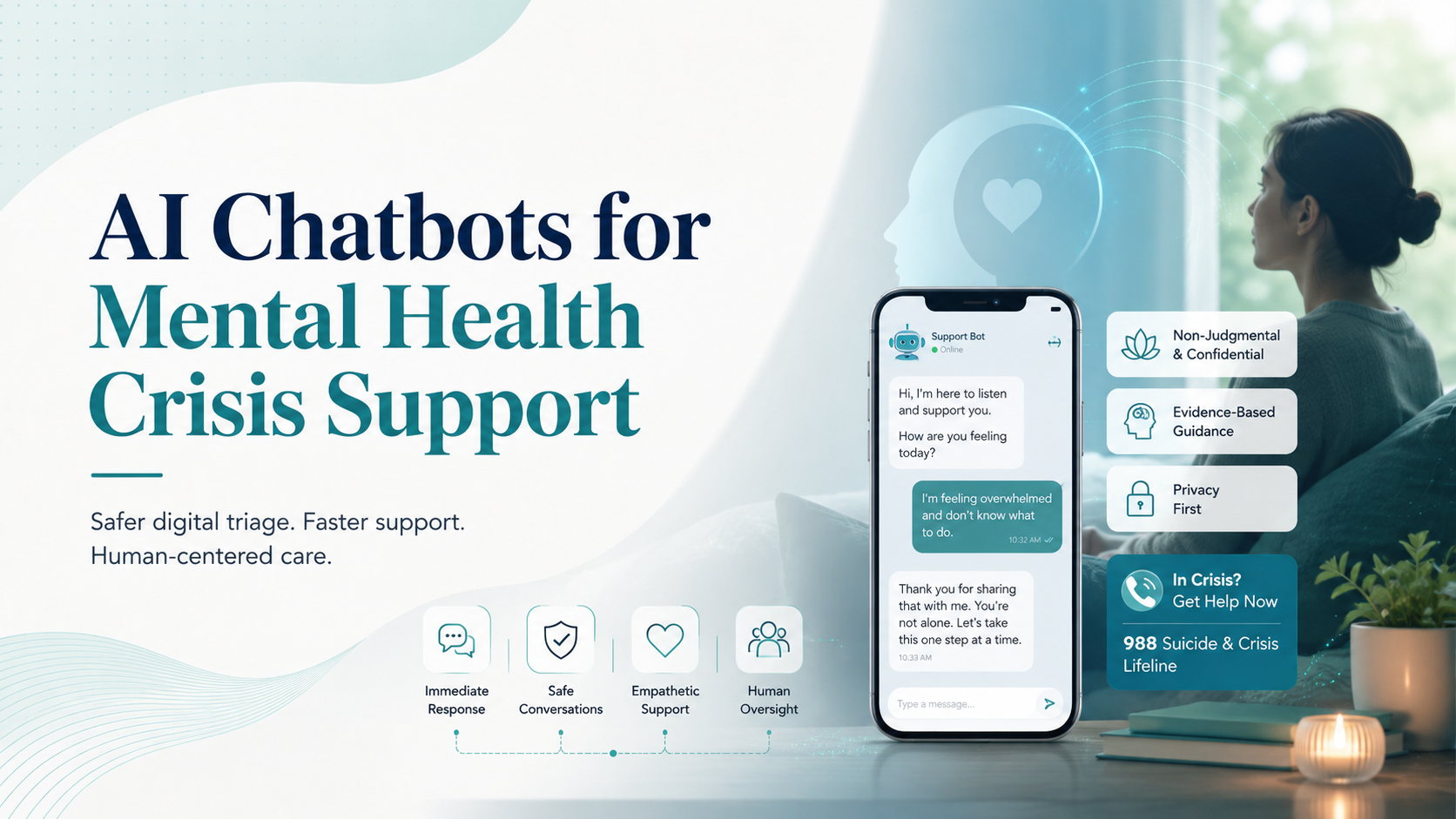
AI chatbots for mental health crisis support function as conversational tools that respond to distress signals with structured prompts, breathing exercises, and grounding techniques. These systems draw on natural language processing to detect words associated with self-harm, panic, or suicidal ideation. When such language appears, well-designed chatbots redirect users toward human crisis services rather than continuing the conversation alone.
The core value sits in the gap between feeling overwhelmed and reaching a human responder. A person awake at 3 a.m. in Kuching or Kuala Lumpur may not find an available counsellor, but a chatbot remains online. That instant availability matters because crisis moments do not follow business hours.
Key Benefits of AI Chatbots for Mental Health Crisis Support
- Round-the-clock availability that removes waiting time as a barrier to first contact.
- Anonymity that lowers the hesitation many people feel before disclosing distress.
- Consistent coping prompts such as paced breathing and sensory grounding exercises.
- Private text-based conversation that suits people uncomfortable with phone calls.
- Scalable first response that can serve many users simultaneously without queue delays.
Research on chatbot-based mental health apps, including reviews of tools like Wysa and Woebot, shows users value the judgment-free environment and the sense that the bot becomes a caring presence. The same research cautions that convenience does not make a chatbot a replacement for therapy. A bot can help immediately in a crisis, but what counts as a crisis to a chatbot may differ from what a trained clinician would identify.
Anonymity and Low Barrier of AI Chatbots for Mental Health Crisis Support
The anonymity of AI chatbots for mental health crisis support creates a lower entry point than walking into a clinic or calling a helpline. Many people in Malaysia hesitate to seek help because of stigma around mental illness, family expectations, or fear that a colleague might overhear a phone conversation. Typing to a chatbot removes those social risks.
This low barrier encourages earlier help-seeking. A person who would not call Befrienders Kuala Lumpur might open a chatbot app during a difficult night. That first step can normalise talking about distress and build momentum toward professional care. The chatbot acts as a gateway, not a destination.
Yet anonymity has a trade-off. Because the user never builds a relationship with a consistent human provider, the chatbot cannot track subtle changes in mood across sessions the way a therapist would. It also cannot observe body language, tone of voice, or the pauses that carry meaning in human conversation.
AI Chatbots for Mental Health Crisis Support Cannot Replace Licensed Professionals
Clinical judgment requires training, context, and accountability that AI chatbots for mental health crisis support do not possess. A licensed psychologist or psychiatrist in Malaysia has studied assessment methods, understands medication interactions, and carries legal and ethical responsibility for patient outcomes. A chatbot has none of those qualifications.
Generative AI models are designed to produce plausible text, not to diagnose conditions or evaluate suicide risk. They may respond with empathy that feels genuine, but that empathy is pattern-matching rather than understanding. Experts at Teachers College, Columbia University warn that generative AI tools offer relationships that feel genuine and impactful but are not a replacement for human connection. Therapy involves more than conversation; it involves formulation, treatment planning, and professional accountability.
Consider the difference in a crisis scenario. A person says, "I want to end my life." A trained crisis responder has protocols for assessing immediacy, means, and protective factors. A chatbot might offer a helpline number, which is appropriate, or it might respond in a way that unintentionally validates the feeling. The stakes of error are simply too high for unsupervised AI in acute situations.
Risk of Validation Spirals with Generative AI Chatbots for Mental Health Crisis Support
Generative AI chatbots for mental health crisis support carry a specific risk called a validation spiral. Because these models are trained to be agreeable and empathetic, they may reinforce negative thought patterns instead of challenging them. A user who says, "Everyone hates me," might receive a response that validates that belief rather than questioning its accuracy.
Cognitive behavioural therapy works partly by helping people identify distorted thinking. A chatbot that always agrees undermines that process. The National Academy of Medicine has convened workshops examining what works and what harms in AI chatbots for mental health, reflecting growing concern among clinicians about unmonitored emotional support tools.
This risk intensifies with general-purpose chatbots like ChatGPT or Replika, which are not designed for crisis intervention. A user seeking support might receive comforting but clinically inappropriate responses. The chatbot cannot recognise when agreement is harmful or when a user needs referral to emergency services.
Privacy and Data Security Concerns with AI Chatbots for Mental Health Crisis Support
Mental health conversations contain some of the most sensitive personal data a person can share. AI chatbots for mental health crisis support collect this data by design, yet privacy protections vary widely between apps. Some store conversation logs on cloud servers; others use data to train models; few offer the confidentiality guarantees that clinical records carry in Malaysia.
Users may not read privacy policies before disclosing distress. They might assume a conversation with a bot is private, when in fact the data could be accessible to the app developer, advertisers, or third-party processors. This creates a real tension. the anonymity that encourages disclosure may not protect the data after disclosure occurs.
Clinical records in Malaysia are protected by professional obligations and medical confidentiality standards. Chatbot data typically falls outside those protections. Before using any mental health chatbot, a person should check what data is collected, where it is stored, and whether it can be deleted.
Comparison. AI Chatbots versus Human Crisis Support
| Factor | AI Chatbot | Human Crisis Support |
|---|
| Availability | 24/7 without exception | Depends on staffing and service hours |
| Anonymity | High perceived anonymity | Varies by service; phone may show number |
| Clinical judgment | None; pattern-based responses | Trained assessment and risk evaluation |
| Safety protocols | Inconsistent across apps | Established crisis intervention procedures |
| Cost | Often free or low subscription | Free for helplines; paid for professionals |
| Immediacy | Instant response | Possible wait time during high demand |
| Emotional understanding | Simulated empathy | Genuine human connection |
| Data privacy | Varies; often unclear | Professional confidentiality standards |
This comparison clarifies the practical decision framework. AI chatbots for mental health crisis support suit low-to-moderate distress, after-hours moments, and people who need a private first conversation. Human support becomes necessary when distress is severe, when there is any indication of self-harm, or when the user needs ongoing therapeutic work.
Verified Crisis Helplines in Malaysia Complement
Malaysia has a network of verified helplines that provide free, confidential crisis support from trained responders. These services complement AI chatbots for mental health crisis support by offering the human judgment and accountability that automated systems lack. FindAHelpline lists these verified services for Malaysia:
- Talian HEAL (Help with Empathy And Love) at 15555, a government-supported mental health helpline.
- Talian Kasih at 15999, which handles crisis and social support cases.
- Befrienders Kuala Lumpur, offering emotional support for those in distress.
- MIASA Crisis Helpline, run by the Malaysian Mental Health Association.
- Life Line Association Malaysia, providing telephone counselling and support.
- PT Foundation's Peer Listening Helpline, focused on peer support.
- Buddy Bear Helpline, serving children and young people.
- WCC Penang and Pusat Perkhidmatan Wanita, supporting women in crisis.
These helplines operate with trained volunteers and staff who follow crisis intervention protocols. They can assess risk, provide immediate emotional support, and connect callers to local services. A chatbot cannot perform these functions with the same reliability.
The practical approach combines both resources. Use an AI chatbot for immediate coping prompts and emotional regulation exercises during non-crisis moments. When distress escalates, when thoughts of self-harm appear, or when the conversation feels beyond what a bot can handle, contact a verified human helpline without delay.
For those in Malaysia, the helpline numbers above are the safest first call during an acute crisis. AI chatbots for mental health crisis support serve best as a supplement to these services, not as a substitute for them. The technology continues to improve, but human responders remain the essential safety net.