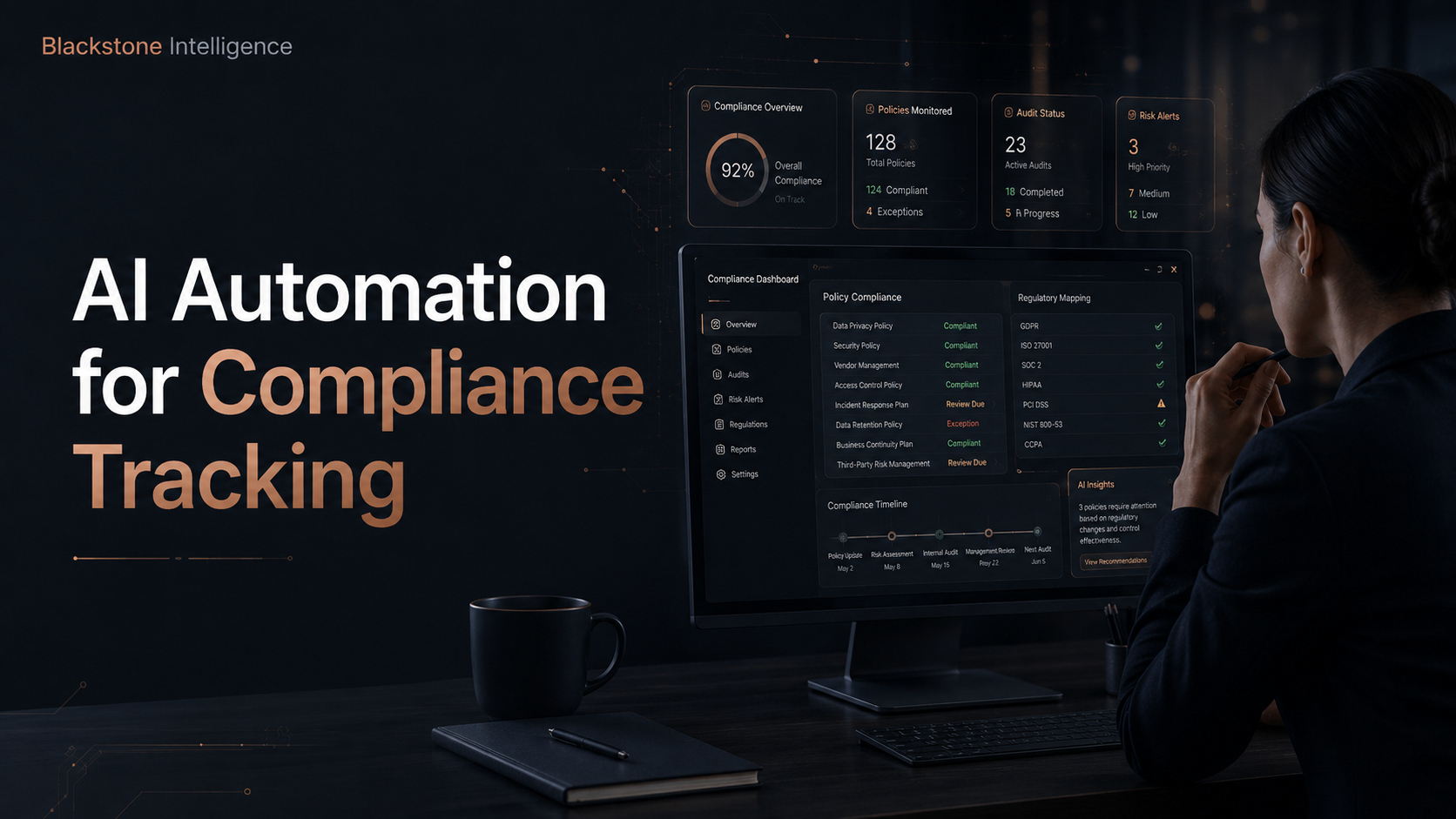
What Is AI Automation for Compliance Tracking?
AI automation for compliance tracking replaces manual spreadsheet checks and calendar reminders with systems that watch regulatory changes, scan internal activities, and log evidence in real time. Instead of waiting for a quarterly review, the software continuously compares business operations against required standards and alerts the compliance team when something falls out of line.
This approach matters because compliance obligations rarely stay static. Regulations shift, deadlines move, and internal processes change. A tracking system powered by AI can absorb new rules, map them to existing obligations, and show exactly where the organization stands at any moment. The output is not a single report but a live picture of compliance status across departments.
For Malaysian organizations, the practical value sits in reducing the time spent on repetitive verification work. Teams that currently pull data from multiple systems, check it against policy documents, and prepare evidence for auditors can hand much of that collection and comparison work to automated workflows.
Why Malaysian Businesses Need AI Automation for Compliance Tracking
Malaysian companies operate under layered obligations that span data protection, financial reporting, industry-specific licensing, and employment law. Keeping track of every requirement manually becomes harder as the business grows and as regulators update their expectations. AI automation for compliance tracking gives compliance officers a single view of what must be done, what has been completed, and what evidence exists to prove it.
The cost of missing a compliance deadline extends beyond fines. A lapse can delay license renewals, slow down business deals, or damage the trust of partners and customers. Automated tracking reduces that risk by catching issues early, often before they become formal problems.
Smaller teams gain the most relative benefit. A large corporation may have a dedicated compliance department, but a mid-sized Malaysian firm often assigns compliance duties to a manager who also handles operations. For that person, automation removes the burden of remembering every deadline and hunting for documents when an auditor asks for them.
Key Capabilities of AI Automation for Compliance Tracking
Different tools approach compliance tracking from different angles, but the strongest systems share a set of core functions. Understanding these capabilities helps separate genuine automation from simple digital checklists.
- Continuous regulatory monitoring that watches for changes in laws and standards relevant to the organization's industry and location.
- Automated evidence collection that captures records, timestamps, and audit trails without requiring staff to manually upload documents.
- Obligation mapping that connects each regulatory requirement to the specific internal controls and activities that satisfy it.
- Risk scoring that prioritizes which compliance gaps need attention first based on likelihood and potential impact.
- Workflow triggers that assign remediation tasks to the right people and escalate unresolved issues automatically.
- Reporting dashboards that show compliance status across frameworks in a format auditors and management can review quickly.
These capabilities work together. Regulatory monitoring feeds obligation mapping, which determines what evidence must be collected. Risk scoring decides the order of remediation. The dashboard ties everything into a view that supports both daily management and formal audits.
Continuous Monitoring vs. Periodic Checks
The shift from periodic to continuous monitoring is the defining difference in modern compliance tracking. Traditional approaches review compliance at set intervals, such as monthly or quarterly. AI automation for compliance tracking checks continuously, so a breach or missed requirement surfaces within hours rather than weeks.
Continuous monitoring also changes how audits feel. Instead of scrambling to assemble evidence when an auditor arrives, the organization already holds a complete, timestamped record of its compliance activities. This reduces stress and shortens the audit cycle considerably.
Human Oversight in Automated Compliance
Automation does not remove the need for human judgment. AI systems excel at collecting data, spotting patterns, and flagging anomalies, but they cannot interpret ambiguous regulations or decide how to handle a novel situation. Effective implementations keep a compliance professional in the loop for review and final decisions.
This division of labor matters for accountability. When a regulator asks who made a decision, the answer must be a person, not a software vendor. Automated tracking supports human accountability by providing the evidence trail, while the compliance officer retains responsibility for interpretation and action.
How to Choose AI Automation for Compliance Tracking
Selecting the right system starts with understanding the specific obligations the organization must track. A tool built for financial services may not suit a healthcare provider or a logistics company. The evaluation should begin with a clear inventory of applicable regulations, internal policies, and reporting deadlines.
Integration capability ranks high on the selection criteria. Compliance tracking draws on data from HR systems, financial software, operational platforms, and document management tools. A system that cannot connect to these sources will require manual data entry, which defeats the purpose of automation.
Scalability matters for growing businesses. A solution that works for a single office may struggle when the company adds branches or enters new regulated activities. Buyers should ask how the system handles additional users, new regulatory frameworks, and increased data volumes.
Vendor support and local knowledge also deserve attention. Malaysian regulations have specific local characteristics, and a vendor that understands the local compliance landscape can configure the system more accurately than one applying a generic global template.
Implementing in Your Organization
Implementation succeeds when it starts small and expands based on proven results. A phased approach reduces disruption and gives the compliance team time to adjust to new workflows.
The first phase should map existing compliance obligations and identify which ones carry the highest risk or consume the most staff time. These become the initial automation targets. Trying to automate every compliance process at once overwhelms the team and produces poor data quality.
Data preparation is the hidden workload in most implementations. Automated tracking only works well when the underlying data is accurate, complete, and consistently formatted. Organizations should audit their current records before connecting them to an automated system.
Training matters more than software configuration. Compliance staff need to understand what the system does, what it does not do, and how to respond when it flags an issue. Clear escalation paths ensure that automated alerts lead to action rather than being ignored.
Blackstone Intelligence, a Kuching-based AI systems agency, applies this kind of governed approach across its automation work. The company's projects for institutions like University Technology Sarawak and the Sarawak Premier's Department show a consistent pattern: structured information, clear review checkpoints, and human accountability preserved within automated workflows. The same delivery principles apply to compliance tracking, where sensitive data and regulatory obligations demand careful system design.
Measuring success requires defined metrics from the start. Common indicators include the time taken to prepare for audits, the number of missed deadlines, the speed of issue detection, and the volume of manual compliance work eliminated. These measures show whether the automation delivers real value or simply adds another system to manage.
AI automation for compliance tracking is not a one-time project but an ongoing capability. Regulations change, business operations evolve, and the system must be reviewed and updated to stay aligned. Organizations that treat it as a continuous improvement cycle gain the most durable benefit.