Core Capabilities of AI Chatbots for Remote Learning
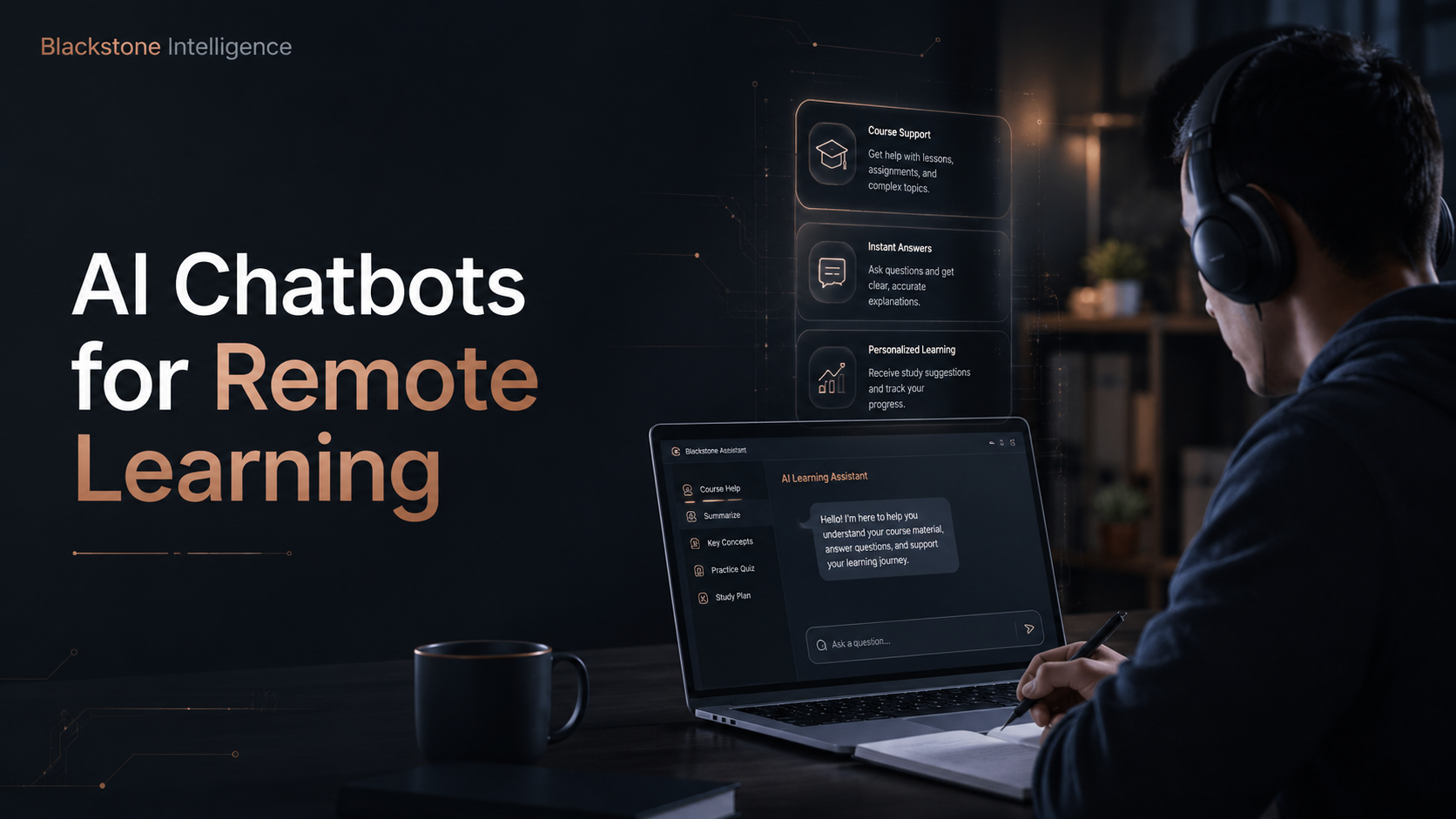
AI chatbots for remote learning operate on large language models that interpret student questions and generate context-aware responses. These systems use natural language processing to understand intent, retrieve relevant information from connected knowledge bases, and present answers in conversational formats. The underlying architecture typically combines a language model with retrieval systems that pull from course materials, institutional policies, or curated academic content.
Modern educational chatbots extend beyond simple question-and-answer functions. They can simulate tutoring dialogues, generate practice problems, explain concepts at different difficulty levels, and adapt responses based on learner progress. Some platforms integrate directly with learning management systems to track student interactions and feed performance data back to instructors.
Course-specific chatbots trained on particular syllabi tend to produce more accurate responses than general-purpose tools. When a chatbot has access to the actual readings, lecture notes, and assignment rubrics for a course, its answers align more closely with what the instructor expects. General tools like ChatGPT or Claude draw from broader training data and may not reflect the specific requirements of a given class.
Benefits for Students. Instant Help and Custom Pace
The primary advantage of AI chatbots for remote learning is their availability. Students studying at night, across time zones, or during irregular schedules can access help when human tutors are offline. This 24/7 availability removes the friction of waiting for office hours or email responses, which matters most for distance learners who may not share a campus schedule with their instructors.
Personalized learning emerges from the chatbot's ability to adjust explanations based on student responses. A learner struggling with a foundational concept receives simpler language and more examples, while an advanced student can request deeper theoretical treatment. This adaptive pacing is difficult for human instructors to deliver consistently across large remote classes.
Key benefits that recur across education technology evaluations include:
- Immediate feedback on practice problems and draft responses, reducing the delay between effort and correction
- Unlimited patience for repetitive questions, allowing students to ask the same concept in multiple ways without embarrassment
- Consistent availability across weekends, holidays, and late-night study sessions
- Reduced anxiety for students who hesitate to ask questions in live virtual classes
- Scaffolded explanations that break complex topics into smaller, digestible steps
- Progress tracking that shows learning patterns and identifies recurring misconceptions
Students also use chatbots as study partners for exam preparation. Tools like Perplexity excel at research tasks because they cite sources, enabling learners to verify information and explore original materials. This source-checking capability supports deeper engagement than receiving an unsourced answer.
Teacher Workload Reduction and Administrative Support
AI chatbots for remote learning reduce teacher workload by handling routine administrative questions that consume significant time. Course logistics, assignment deadlines, grading rubrics, and institutional policies are common queries that chatbots can answer from approved information sources. This frees educators to focus on instructional design, meaningful feedback, and direct student interaction.
Institutions have deployed chatbots for student support navigation with measurable success. The Students Development Services Centre at University Technology Sarawak worked with Blackstone Intelligence to organize support topics, approved information, response paths, and escalation rules into a governed knowledge flow. This framework created a more consistent student support journey that can be updated as services change, demonstrating how AI agents handle repeated enquiries while maintaining human accountability.
For formative assessment, chatbots can generate quiz questions, evaluate short-answer responses against rubrics, and provide preliminary feedback that instructors review before release. This workflow does not replace teacher judgment but accelerates the mechanical parts of assessment. The educator remains the final authority on grades and substantive feedback.
Teachers also use chatbots to differentiate instruction at scale. A single teacher managing dozens of remote students can assign different chatbot personas or knowledge bases to different learner groups, ensuring each receives appropriately leveled support without the teacher personally authoring every variation.
Challenges and Mitigation Strategies
Academic integrity concerns dominate discussions of AI chatbots for remote learning. Students may submit chatbot-generated work as their own, bypassing the learning process. Institutions respond through several mechanisms: plagiarism detection tools that identify AI-generated text, assessment redesign that emphasizes process over final product, and explicit policies that define acceptable chatbot use. Some educators require students to document their chatbot interactions, treating the tool as a tutor rather than an answer generator.
Accuracy limitations present another challenge. Language models can produce confident but incorrect responses, particularly for niche or rapidly changing subjects. Mitigation requires grounding chatbots in verified course materials, implementing retrieval-augmented generation that cites sources, and training students to cross-check important facts. Perplexity's citation model offers a useful pattern for educational contexts.
Data privacy and student safety require careful platform selection. Educational chatbot makers like Edcafe AI, MagicSchool AI, and SchoolAI emphasize compliance with student data regulations including FERPA, COPPA, and GDPR. Institutions should verify that any chatbot tool stores student data securely, does not use conversations for unrelated model training, and provides administrative controls for data retention and deletion.
Bias in AI responses reflects biases in training data. Chatbots may produce culturally insensitive content or reinforce stereotypes if not carefully monitored. Human oversight, diverse training data, and regular auditing of chatbot outputs help mitigate these risks. Institutions should establish clear escalation paths when chatbot responses require human intervention.
Over-reliance on chatbots can reduce critical thinking if students treat AI answers as authoritative. Educators counter this by designing assignments that require evaluation of chatbot responses, comparison across sources, and reflection on the limitations of AI-generated content. Teaching responsible chatbot use as a digital literacy skill prepares students for workplaces where AI assistance is increasingly standard.
Top AI Chatbots for Remote Learning Compared
Several AI chatbots for remote learning have established strong reputations through testing and classroom use. The table below compares leading options based on features, pricing, and observed strengths and limitations.
| Tool | Key Features | Pricing | Pros | Cons |
|---|
| ChatGPT | General reasoning, writing support, code generation, multimodal input | Free tier; Plus subscription approximately $20/month | Broad knowledge, strong writing assistance, widely adopted | Can produce inaccurate answers, requires prompt skill, not course-specific |
| Khanmigo | Dedicated AI tutor, Socratic questioning, curriculum alignment | Subscription-based through Khan Academy | Designed for education, emphasizes guided learning over direct answers | Limited to Khan Academy content scope |
| Claude | Deep explanations, structured reasoning, long-context understanding | Free tier; Pro plan approximately $20/month | Excellent for complex conceptual explanations, careful writing | Less integrated with educational platforms |
| Perplexity | Research with citations, source verification, up-to-date web access | Free tier; Pro plan approximately $20/month | Cited answers support verification, strong for research tasks | Less suited to sustained tutoring dialogues |
| Google Gemini | Google Workspace integration, multimodal study support | Free tier; Google AI Pro plan available | Seamless with Google tools, handles images and documents | Quality varies by task, privacy considerations with Google data |
ChatGPT earns consistent recognition as the best overall AI learning chatbot due to its versatility and strong performance across writing, explanation, and problem-solving tasks. Khanmigo stands apart as the only dedicated AI tutor in this group, built specifically to guide students through material using Socratic questioning rather than simply supplying answers.
Claude distinguishes itself for deep explanations and structured reasoning, making it valuable for subjects that require careful logical development. Perplexity serves research-heavy coursework where source verification matters more than conversational tutoring. Google Gemini suits students already embedded in the Google ecosystem who need multimodal support for documents, slides, and images.
For teachers building custom chatbots, platforms like Edcafe AI, MagicSchool AI, and SchoolAI offer no-code builders with classroom-specific features. These tools allow educators to create persona-based chatbots, control knowledge sources, monitor student conversations, and comply with student data regulations. They differ from general chatbots by prioritizing teacher oversight and educational workflows.
How to Choose the Right AI Chatbot for Remote Learning Needs
Selecting among AI chatbots for remote learning requires matching the tool to the specific educational context. A university lecturer supporting research-heavy graduate students needs different capabilities than a primary school teacher introducing young learners to AI concepts.
Start by defining the primary use case. Students seeking homework help and concept explanations benefit from general-purpose chatbots like ChatGPT or Claude. Learners conducting research projects need citation capabilities found in Perplexity. Institutions wanting consistent, policy-aligned support across many students should consider custom chatbots built on approved knowledge bases, similar to the student support agent developed for University Technology Sarawak.
Evaluate the subject matter complexity. STEM subjects with well-defined problem-solving steps respond well to chatbot tutoring. Humanities and social sciences require more nuanced discussion where chatbot limitations become apparent. For subjects with evolving information, ensure the chatbot has access to current, verified sources rather than relying on static training data.
Consider the technical infrastructure. Standalone chatbots require no institutional setup but offer limited oversight. Chatbot makers designed for education provide dashboards where teachers monitor interactions, review flagged content, and adjust chatbot behavior. Integration with existing learning management systems reduces friction for both students and administrators.
Assess privacy and compliance requirements before deployment. Malaysian institutions must consider the Personal Data Protection Act alongside any platform-specific commitments. Verify where student data is stored, whether conversations train external models, and what controls exist for data deletion. Educational chatbot platforms that emphasize FERPA and COPPA compliance typically offer stronger privacy protections than consumer tools.
Budget constraints shape the decision between free tiers and paid subscriptions. Most major chatbots offer free versions sufficient for casual use, while premium plans unlock advanced features, higher usage limits, and priority access. Khanmigo and custom educational platforms generally require paid subscriptions but provide education-specific functionality that general tools lack.
Pilot the chatbot with a small group before institutional adoption. Gather feedback on response quality, student satisfaction, and any technical issues. Compare performance against the specific learning objectives rather than generic benchmarks. A chatbot that excels at one subject or age group may perform poorly in another context.
Plan for human oversight from the start. AI chatbots for remote learning work best as supplements to human instruction, not replacements. Establish clear escalation paths for questions chatbots cannot answer, review chatbot interactions periodically for quality, and maintain human responsibility for assessment and sensitive student matters. This governed approach aligns with how Blackstone Intelligence structures AI systems for education clients, preserving human accountability while automating routine support.
Finally, revisit the choice as both chatbot capabilities and institutional needs evolve. The rapid pace of AI development means today's best tool may be surpassed within months. Build evaluation criteria that allow periodic reassessment without disrupting established workflows.