Introduction
Blackstone Intelligence built Settlement Lab for Jurutera Perunding Geon Sdn Bhd. The tool supports construction-stage ground-settlement monitoring by connecting site observations, measurements, supporting evidence and draft reports in one workspace.
The project addresses a practical engineering task: preserving the context behind each reading so that a reviewer can understand what was measured, what was observed on site and which approved reference was used.
Challenges
Settlement monitoring involves more than entering a number. Monitoring points, dates, units, baseline levels, fill stages, instrument condition and weather can all affect how a record should be interpreted. Photos, voice notes and source documents need to remain connected to the relevant observation.
When those items sit in separate notebooks, spreadsheets and message threads, compiling a reviewable report becomes harder. The software aims to make recording and retrieval more consistent while keeping engineering judgement with the qualified reviewer.
Solution
Site recording and evidence
Inspectors can capture readings against registered monitoring points, record site conditions and add follow-up observations. Browser-supported speech recognition can help turn spoken observations into editable text, while a separate recording function preserves the original audio as linked evidence. Microphone permission and a compatible browser are required.
Photos, documents and recordings can be linked to monitoring points or events. Device drafts help recover unfinished forms. New readings remain drafts until their source, units, observation and reference have been checked; verified records are protected against editing through the application.
Settlement analysis and graphs
A deterministic calculation engine converts supported survey-level or cumulative-settlement inputs into a consistent analysis. It calculates increments and rates, compares readings with an engineer-approved time curve, and reports deviation and remaining settlement relative to that reference.
Registered alert and action thresholds identify records needing review. Reference versions and source snapshots remain linked to the analysis. The tool does not invent an approved reference curve when one is missing or independently forecast ground behaviour.
The PDF workflow uses text extraction, OCR and a connected vision model to help recover settlement schedules and readable source text. Supported embedded tables can use local extraction. Image-only scans depend on the AI service being available.
Imported readings remain drafts for comparison with the original document. The interface can plot fill elevation and settlement against cumulative days while preserving source signs, datum information and relevant remarks.
AI report drafting and project assistant
The connected DeepSeek service can draft a monitoring narrative from a fixed report snapshot. Numerical fields come from the calculation engine, and the report retains its source context for qualified review before approval.
The AI assistant supports questions about latest readings, settlement history and trigger points. Its constrained query planner compiles supported requests into read-only database queries. Graph-linked evidence and keyword retrieval help bring relevant context into source-cited answers. This supports checking and explanation without handing numerical calculation to free-form AI generation.
Records and review
Project data, uploaded evidence, reference versions and audit records are stored in a persistent workspace. CSV and project exports support technical review and record keeping. AI drafting and extraction send selected content to the configured provider when explicitly requested; the system is not entirely offline.
Impact
Settlement Lab brings field capture, calculation, evidence retrieval and report preparation into a connected workflow for Geon. Engineers can trace observations back to their source, review settlement progression and prepare reports from a consistent set of records.
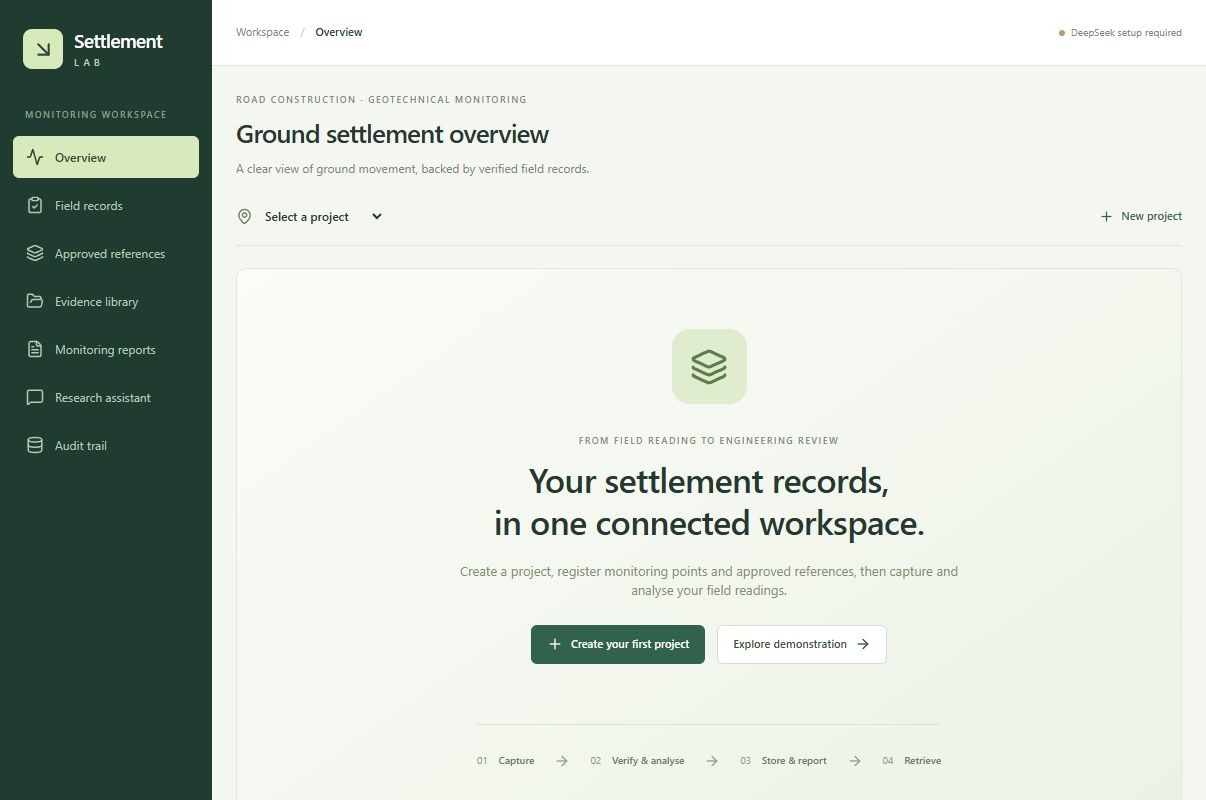
The showcase image contains no client project records. Qualified engineers retain responsibility for checking inputs, interpreting results and approving reports. The tool supports that review process and preserves the evidence behind each assessment.