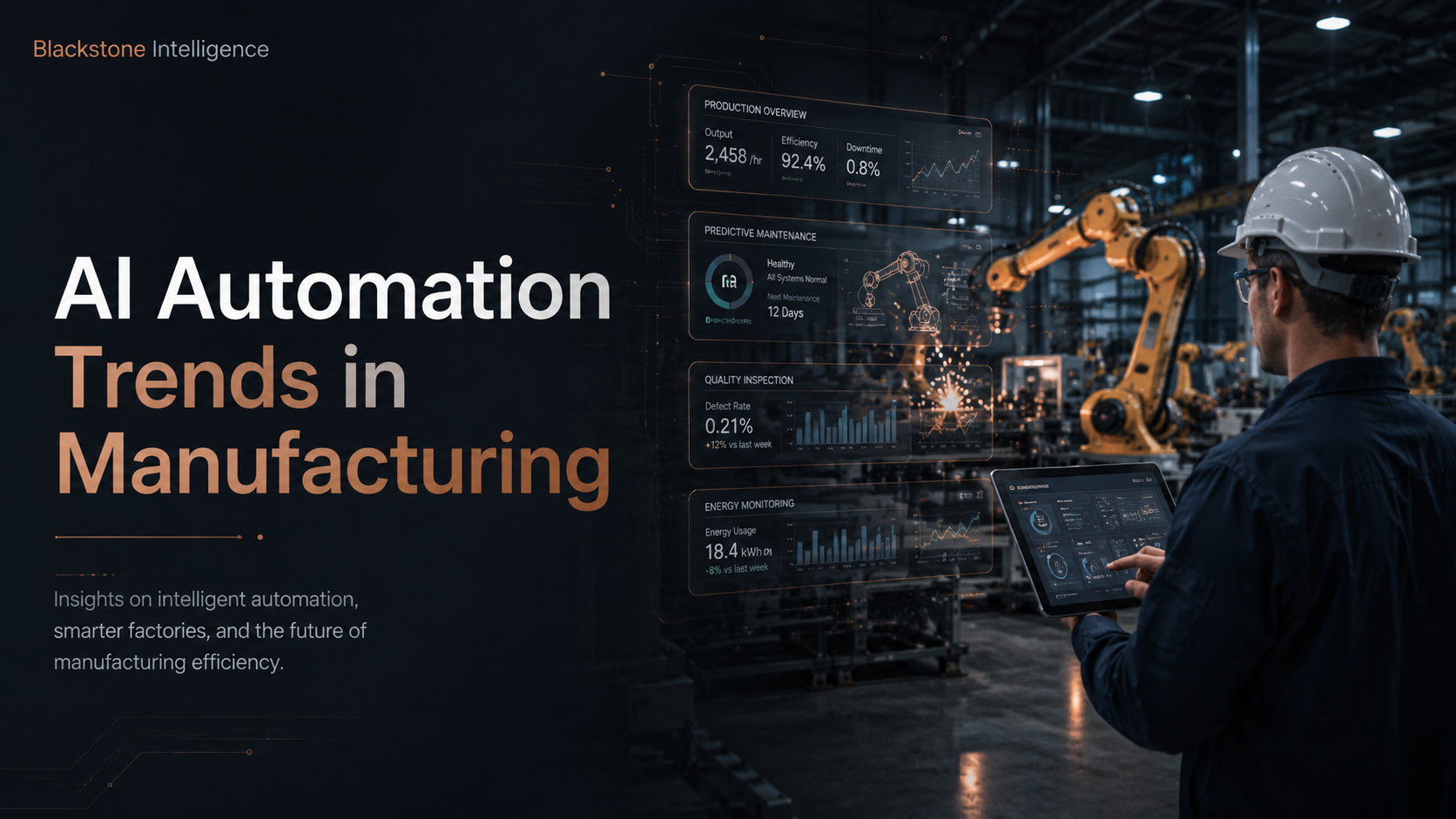
AI automation trends in manufacturing center on predictive maintenance, AI agents, and edge AI, with PwC projecting that highly automated key processes will more than double from 18% to 50% by 2030.
Why AI Automation Trends in Manufacturing Matter for Malaysia
Manufacturing is a core pillar of Malaysia's economy, and the global shift toward intelligent production carries direct consequences for local plants. The gap between leaders and laggards is widening, not narrowing. PwC's Global Industrial Manufacturing Sector Outlook reports that the share of industrial manufacturers expecting to highly automate key processes by 2030 will more than double, from 18% to 50%. Plants that delay adoption risk falling behind competitors who can respond faster to order changes, quality issues, and supply disruptions.
For Malaysian manufacturers, the relevance is practical. Labour costs are rising, export customers increasingly demand traceability and consistent quality, and regional competitors are investing heavily in automation. Understanding AI automation trends in manufacturing is no longer an optional technology review; it is a competitive necessity. The trends shaping global factories are the same ones that will determine which Malaysian plants win export contracts and which struggle to maintain margins.
Key AI Automation Trends in Manufacturing for 2026
The most credible sources converge on a clear set of developments. These are not speculative ideas but patterns already visible in industry surveys and analyst observations.
Predictive maintenance shifts equipment monitoring from reactive repairs to condition-based intervention, using sensor data and machine learning to flag failures before they stop production.
AI agents and agentic workflows automate multi-step processes such as order exceptions, inventory reconciliation, and supplier follow-ups without constant human prompting.
Edge AI moves inference closer to machines and sensors, reducing latency for vision inspection and quality control while cutting reliance on cloud connectivity.
Digital twins create live virtual models of production lines, letting engineers test changes and simulate outcomes without disrupting actual operations.
Physical AI combines robotics with learning systems, though industry observers note the rollout will take time and the hype currently outpaces deployment.
Cybersecurity for operational technology grows in importance as more connected devices create larger attack surfaces on the factory floor.
Predictive Maintenance and Quality Control
Predictive maintenance remains one of the most commercially proven applications. Equipment monitoring shifts from reactive to predictive, meaning maintenance teams receive alerts based on vibration, temperature, and acoustic data rather than fixed schedules. The payoff is reduced unplanned downtime and longer equipment life. Quality control follows a similar pattern. Vision systems powered by machine learning catch defects before products leave the line, reducing scrap and rework costs. These two applications often serve as entry points because they deliver measurable returns on a single production line without requiring a full plant-wide transformation.
AI Agents and Workflow Automation
Redwood's Manufacturing AI and Automation Outlook 2026 found that 98% of manufacturers are exploring AI, but only 20% feel fully prepared. That gap between interest and readiness is where AI agents become relevant. AI agents handle exception management in workflows that span enterprise resource planning, manufacturing execution systems, and inventory management. When a data transfer fails or an order hits an anomaly, an agent can investigate, escalate, or resolve the issue. The technology is cost-effective relative to full robotic automation, making it accessible to mid-sized plants that cannot justify large capital expenditure.
Edge AI and Digital Twins
Edge AI is expanding beyond vision use cases into broader industrial applications. Running models directly on factory-floor hardware reduces the delay between data collection and action, which matters for real-time quality decisions. Digital twins complement this by providing a sandbox for testing. Engineers can simulate a new production schedule, evaluate energy consumption, or validate a changeover procedure before touching physical equipment. Together, edge AI and digital twins support the software-defined automation trend that industrial analysts identify as an innovation priority.
How Malaysian Manufacturers Can Prepare for AI Automation
Preparation does not begin with purchasing software. It begins with understanding current operations and data flows. A practical sequence for a Malaysian plant considering these AI automation trends in manufacturing follows a clear logic.
First, audit data readiness. AI models depend on clean, structured data from machines, quality systems, and enterprise software. Many plants discover that their data sits in disconnected silos or spreadsheets. Second, identify one high-value use case rather than attempting a plant-wide rollout. Predictive maintenance on a critical machine or automated quality inspection on a bottleneck line provides a testable proof point. Third, build the integration layer. AI systems need to connect with existing ERP, MES, and database infrastructure to act on insights. Fourth, establish human oversight and escalation rules. AI agents should triage issues and flag exceptions for human review, not make irreversible decisions autonomously. Finally, measure outcomes against baseline performance and expand only after demonstrating results.
The delivery architecture used by AI consultancies mirrors this sequence: assess data readiness, identify high-value use cases, develop a phased roadmap, build custom models where needed, integrate with existing systems, and structure data pipelines for reliable performance. Malaysian manufacturers can apply the same discipline internally or with external partners.
Challenges and Considerations
The obstacles to adoption are as important as the opportunities. Data fragmentation remains the most common barrier. Redwood's research highlights that fragmented systems and poor data readiness prevent manufacturers from scaling automation even when leadership supports it. Many plants run on legacy equipment that predates modern connectivity, requiring retrofitted sensors or middleware to generate usable data.
Workforce readiness is a second constraint. Automation changes job roles rather than simply eliminating them. Technicians need to interpret AI recommendations, engineers need to validate model outputs, and operators need to trust systems that flag problems they cannot see. Training and change management are not peripheral concerns; they determine whether deployed systems actually get used.
Cybersecurity introduces a third layer of complexity. Every connected sensor and AI endpoint expands the attack surface. Manufacturing Dive reports that as companies lean further into automated software, sensor technologies, and robots, they are also using AI tools to bolster cybersecurity. OT security enforcement is shifting closer to industrial assets, meaning security decisions happen at the machine level rather than only at the corporate firewall.
Physical AI deserves particular caution. While the concept attracts significant attention, industry sources note that the rollout will take time. The hype is real, but mainstream deployment across factories will be gradual. Malaysian plants should monitor physical AI developments without treating them as an immediate priority over proven applications like predictive maintenance and workflow automation.
The Future of AI Automation in Manufacturing
The trajectory points toward autonomous operations, but the path is incremental. PwC's outlook indicates that industrial automation will accelerate across the sector, with future-fit manufacturers pulling further ahead of competitors. These leaders share common traits: they treat data as a strategic asset, they integrate AI into core workflows rather than piloting it in isolation, and they invest in workforce capabilities alongside technology.
For Malaysian manufacturers, the practical implication is clear. The window for catching up is not closed, but it is narrowing. Plants that begin with data readiness assessments and focused use cases can build momentum. Those that wait for perfect solutions or industry-wide standards risk being left with legacy processes as competitors capture higher-margin work.
The convergence of AI agents, edge computing, and connected sensors means that even mid-sized plants can now access capabilities that were once reserved for large multinationals. The cost of sensors has fallen, cloud and edge infrastructure is more accessible, and AI development tools have matured. The remaining differentiator is execution discipline: clear use cases, clean data, human oversight, and a willingness to measure and iterate. Malaysian manufacturers that apply this discipline will be well positioned as AI automation trends in manufacturing continue to reshape global production.