
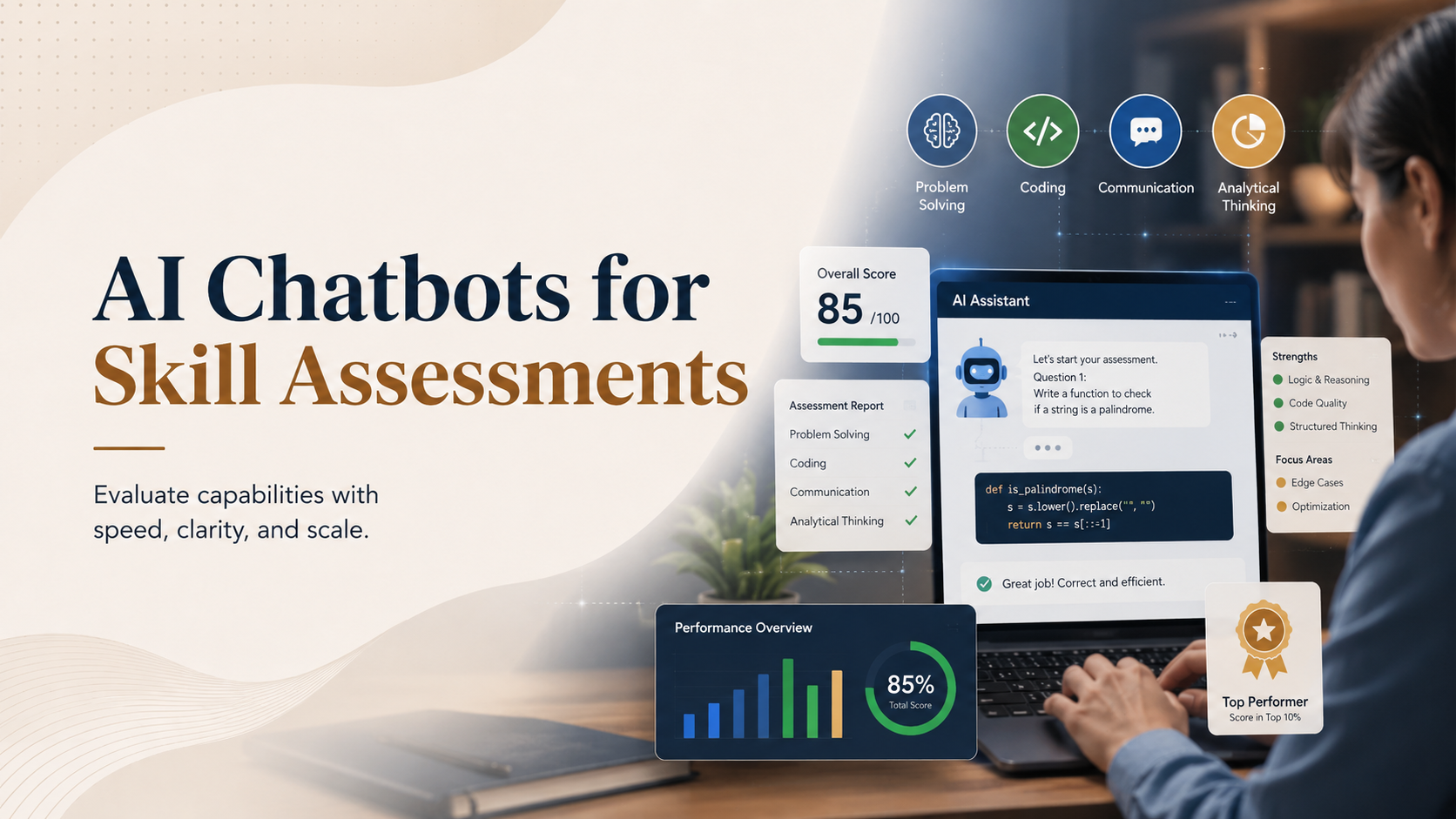
AI chatbots for skill assessments replace static multiple-choice tests with adaptive dialogues that probe reasoning, communication, and role-specific knowledge. These systems ask follow-up questions, simulate workplace scenarios, and score responses against predefined rubrics. The result is a shift from measuring recall to observing how a person thinks and reacts under conversational pressure.
Why Teams Are Turning to AI Chatbots for Skill Assessments
The core appeal of AI chatbots for skill assessments lies in three measurable advantages over traditional testing methods:- Speed: A conversational evaluation can be completed in 30–45 minutes, compared with hours of manual interview scheduling and scoring.
- Scale: Hundreds of candidates can be screened simultaneously without adding recruiter headcount.
- Context: Roleplays and scenario-based questions reveal how candidates apply skills in realistic situations rather than how well they memorize facts.
How Conversational Assessment Works
AI chatbots for skill assessments operate on large language models that generate questions dynamically based on candidate responses. A typical system combines several components:A natural language interface presents questions conversationally, either by text or voice. The underlying model interprets free-form answers rather than forcing candidates into multiple-choice options. A scoring engine then compares responses against criteria set by hiring managers or educators, producing structured output that ranks candidates on defined competencies.Automated Scoring and Feedback Loops
Scoring in AI chatbots for skill assessments relies on rubrics that translate qualitative performance into quantitative results. Communication clarity, problem-solving approach, technical accuracy, and behavioral indicators each receive weighted scores. The chatbot then compiles these into a competency profile that recruiters can compare across applicants. Feedback generation is a secondary but valuable function. Candidates receive immediate explanations of their strengths and gaps, which improves the experience even for those who do not advance. For internal assessments, this same feedback supports personalized learning plans. An employee who struggles with data interpretation, for example, receives targeted recommendations for improvement rather than a simple pass-fail result.Evaluating Multiple Competencies in One Session
AI chatbots for skill assessments excel at measuring several dimensions simultaneously. A single conversation can assess technical knowledge, communication style, adaptability, and cultural fit without requiring separate tests for each attribute. Consider a software engineering assessment. The chatbot might open with a system design question, follow up on trade-offs the candidate mentions, then pivot to a debugging scenario that tests practical knowledge. Throughout the exchange, the model notes how the candidate handles uncertainty, whether they ask clarifying questions, and how clearly they explain technical concepts to a non-specialist. This integrated view is difficult to achieve with traditional testing, where each competency is measured in isolation.Limitations and Bias Considerations
Despite their capabilities, AI chatbots for skill assessments carry significant risks that organizations must manage deliberately.Non-deterministic outputs are the most technical concern. Large language models generate different responses to the same input depending on subtle variations in phrasing, context, and model temperature settings. Two candidates who give essentially identical answers may receive different follow-up questions, producing scores that are not perfectly comparable. This variability undermines the standardization that makes assessments fair.Where AI Chatbots for Skill Assessments Fit Best
The technology is not a universal replacement for human judgment. AI chatbots for skill assessments work best as a first-stage screening tool that narrows a large applicant pool to a manageable shortlist for human interviews. They are less suitable for senior roles where nuanced judgment, leadership presence, and complex interpersonal dynamics matter more than conversational performance. Educational institutions use these systems for formative assessment, where the goal is identifying learning gaps rather than making high-stakes decisions. Corporate training departments apply them to certify that employees have mastered new skills after completing courses. In both contexts, the chatbot serves as a consistent evaluator that supplements rather than replaces human instructors.Implementation Considerations for Malaysian OrganizationsBuilding a Reliable Assessment Framework