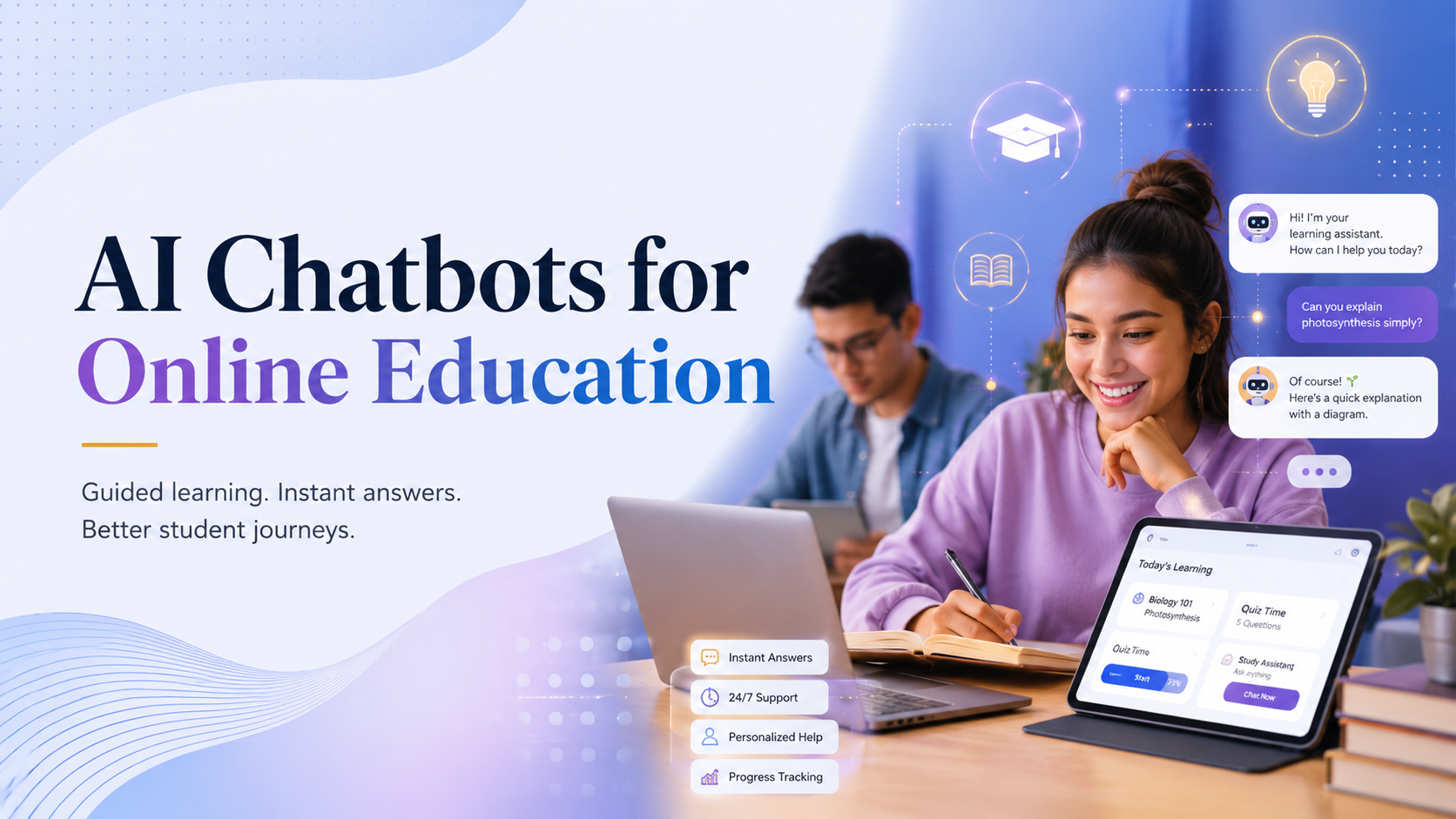
AI Chatbots for Online Education are becoming a standard layer in digital campuses, handling the repetitive questions that once consumed staff time. These systems give instant answers about deadlines, assignments, and policies, and they can guide learners through course material at their own pace. For institutions in Malaysia and beyond, the practical value lies in freeing human educators for deeper instructional work while giving students a responsive first point of contact.
Core Benefits of AI Chatbots for Online Education
The strongest case for adopting AI Chatbots for Online Education rests on measurable improvements in student experience and operational efficiency. Institutions report that chatbots reduce the volume of routine enquiries, improve response consistency, and help students find the right information without waiting for office hours.
Key benefits observed across higher education implementations include:
- 24/7 availability that matches the study patterns of online learners across different time zones.
- Consistent, accurate answers to frequently asked questions about admissions, fees, and course logistics.
- Personalized learning support through adaptive quizzes, flashcards, and guided practice sessions.
- Administrative relief for teaching staff by automating routine enquiries and data collection.
- Scalable support that maintains service quality during peak enrolment periods.
24/7 Student Assistance with AI Chatbots for Online Education
Online learners do not follow a nine-to-five schedule. Many study after work or during weekends, when human support teams are unavailable. AI Chatbots for Online Education fill that gap by providing immediate responses to common questions at any hour.
Georgia State University's Pounce chatbot demonstrates the model in practice. The system reduced summer melt by answering enrolment questions and guiding students through required tasks, showing that a well-designed chatbot can influence real student outcomes. The key mechanism is simple. students receive an answer in seconds rather than waiting for an email reply the next day.
The scope of these conversations matters. A chatbot that only answers "When is the deadline?" provides limited value. Effective systems connect to the institution's knowledge base, pulling accurate information about specific courses, policies, and services. This requires careful content curation rather than a generic language model left to answer freely.
Personalized Tutoring and Learning Support
Beyond administrative answers, AI Chatbots for Online Education support active learning. Stanford's teaching resources describe chatbots used as skills sandboxes, where students practice conversations in a low-stakes environment. Language learners can hold dialogues with a patient bot that never tires of repetition. Medical or counselling students can rehearse difficult conversations before facing real clients.
The pedagogical value extends to self-regulated learning. A Springer study of pre- and in-service teachers using chatbots in an online course found that the tools supported motivation and engagement. Students could test their understanding, receive immediate feedback, and revisit material without the social pressure of asking questions in a forum.
Practical applications include.
- Interactive quizzes that adapt difficulty based on student responses.
- Flashcards and memorization drills for vocabulary or terminology.
- Scenario-based practice for professional skills.
- Anonymous feedback collection that encourages honest responses.
The limitation is accuracy. Chatbots can generate plausible but incorrect answers, particularly for niche subject matter. Institutions must ground responses in verified course content and include clear escalation paths to human tutors when the bot cannot help.
Administrative Automation for Teaching Staff
Teachers spend significant time answering the same questions repeatedly. AI Chatbots for Online Education absorb this workload by handling routine enquiries about assignment submission, grading timelines, and course requirements.
Ohio State University's approach shows how course-specific chatbots can be built to support teaching teams. These systems communicate key course information, reducing the need for instructors to repeat announcements. The result is not replacement of human teaching but redistribution of effort toward higher-value activities like feedback and lesson design.
The administrative use cases extend beyond the classroom:
- Admissions teams use chatbots to qualify prospective students before human counsellors engage.
- IT helpdesks automate password resets and account troubleshooting.
- Financial aid offices answer questions about applications and disbursement schedules.
- Student services direct learners to the correct department without phone tag.
For Malaysian institutions considering this path, the Students Development Services Centre at University Technology Sarawak provides a relevant reference point. Blackstone Intelligence developed an AI agent for student support navigation there, organising approved information and response paths so students receive consistent answers about services, policies, and contacts.
Integrating AI Chatbots for Online Education with Learning Management Systems
A chatbot that exists outside the learning management system (LMS) has limited value. The most effective AI Chatbots for Online Education sit inside the platforms students already use, whether that is Moodle, Canvas, Blackboard, or a custom system.
Integration enables several important functions:
- Course navigation assistance that helps students find modules and resources.
- Progress tracking that reminds learners about incomplete activities.
- Content recommendations based on performance and engagement patterns.
- Assignment submission support with document processing and format checks.
The technical approach matters. Retrieval-augmented generation (RAG) allows the chatbot to pull accurate information from the institution's own documents rather than relying on the model's general knowledge. This reduces hallucination and ensures answers reflect current policies.
Institutions should also consider channel strategy. Some students prefer chat within the LMS; others engage through WhatsApp, Telegram, or other messaging platforms common in Malaysia. A multi-channel deployment reaches students where they already communicate, but it requires consistent content governance across all touchpoints.
Implementation Best Practices for AI Chatbots for Online Education
Successful deployment of AI Chatbots for Online Education follows a structured path rather than a technology-first approach. Institutions that start with clear use cases and governed content achieve better outcomes than those that deploy a model and hope for the best.
The implementation sequence typically involves:
- Identify the highest-volume enquiry categories by reviewing support tickets and common student questions.
- Map the approved answers and escalation paths for each category, ensuring accuracy and policy compliance.
- Select the platform and integration points, considering the existing LMS and communication channels.
- Build a focused prototype that handles the priority use cases before expanding scope.
- Test with real students and staff, collecting feedback on answer quality and user experience.
- Monitor performance metrics including resolution rate, escalation frequency, and student satisfaction.
- Establish a review cycle for updating content as courses, policies, and services change.
Data privacy requires particular attention. Student conversations may contain sensitive information, and institutions must define what data the chatbot collects, where it is stored, and who can access it. Anonymity options, as described in Stanford's use cases, allow students to seek help without fear of judgement.
The cost picture varies widely. Simple rule-based chatbots can be built with modest budgets, while sophisticated AI systems with custom integrations require more substantial investment. Institutions should evaluate total cost including content maintenance, model hosting, and staff training, not just the initial build.
Choosing the Right Approach for Your Institution
The decision to implement AI Chatbots for Online Education should start with institutional priorities rather than vendor promises. A university struggling with enrolment enquiries needs a different solution than one focused on improving learning outcomes.
For Malaysian institutions, local context matters. Student communication preferences, language requirements, and regulatory considerations around data protection all shape the implementation. Working with a team that understands both the technology and the local education landscape reduces the risk of misalignment.
Blackstone Intelligence, based in Kuching, Sarawak, has delivered related projects including the student support AI agent for University Technology Sarawak and AI-supported course development for the same institution. These projects demonstrate the practical application of governed AI systems in Malaysian education, where human oversight and approved information flows remain central to the design.
The path forward is not about replacing educators with bots. It is about building systems that handle the predictable, repetitive work so that human attention goes where it matters most: teaching, mentoring, and supporting students through their learning journey.